JN-004 · Published
Why I created Spontaniius, and why I left it behind
Product Development · Mobile · Distribution
By Quinn Paterson
As a longtime newspaper reader, and as a person living in the 2010s, I had come across the idea of what is now often called the “loneliness crisis.” As someone who at the time had a somewhat limited social network, I started thinking about why that might be, what was causing it, and what might actually help.
Naturally, I landed on building an app.
Half kidding, but while “phones have contributed to rising loneliness” seems like a fairly reasonable hypothesis, there are many possible explanations for why.
What appealed to me at the time, and still does to a fair extent, was the potential disappearance of spontaneous activity. If you only go to bars with friends, then it’s tough to make friends if you don’t have any—a situation I’ve found myself in more than once after moving 20+ times in my life.
Phones in particular can be seen as a barrier here. A lot of the little occasions where people might once have interacted—at gyms, on buses, waiting in line—have become a bit less accessible. When you’re bored, your screen comes out, at which point interrupting you, even if you’re doing nothing in particular, can feel rude—even if you might actually welcome the interaction.
And so, in some mixture of wanting to tackle a social problem, wanting to push myself technically as a junior engineer, and simply being someone who had an idea, I got started. Namely, with an app that would invite anyone around you to interact and join in on whatever activity you were engaging in.
Meetup, an app I have a lot of love for, is excellent for finding events that happen on a regular basis. Spontaniius was my attempt to complement that with something for finding things to do—and inviting people to do them—right now.
There were a few ideas I ended up packing into it that I felt would be useful as a user:
- Quick creation of events, including preset fields for common activities such as grabbing coffee
- Lightweight creation, so that the flow from signup to creating an event could take only a few minutes
- User cards, a mildly fun attempt to combine introductions, tracking who you’d met, some amount of safety, and a little gamification in one place
- An idea to eventually finance the app by allowing venues to promote themselves via deals, ideally creating a win-win-win between venues, organizers, and attendees
In addition, as a software engineering student at the time whose main work experience had been in testing and test automation, I wanted to use the project to push myself into unfamiliar territory. So, in addition to learning Android development, I taught myself backend development through AWS.
As someone uninterested in running a server out of my laptop, I was drawn to a cloud provider and chose AWS due to its overall popularity, wide variety of services, and good free-tier limits. Knowing my app would typically have a low compute load, and wanting to avoid the difficulties of managing EC2 instances, I decided to use Lambda to support the backend.
The app would also require substantial geographic features. I was drawn to PostGIS for its strong out-of-the-box geospatial support, which in turn led me to use RDS for the database.
On the Android side of things, I learned about the performance and load-time costs introduced by repeatedly launching new activities, and eventually moved toward a fragment-oriented, single-activity architecture.
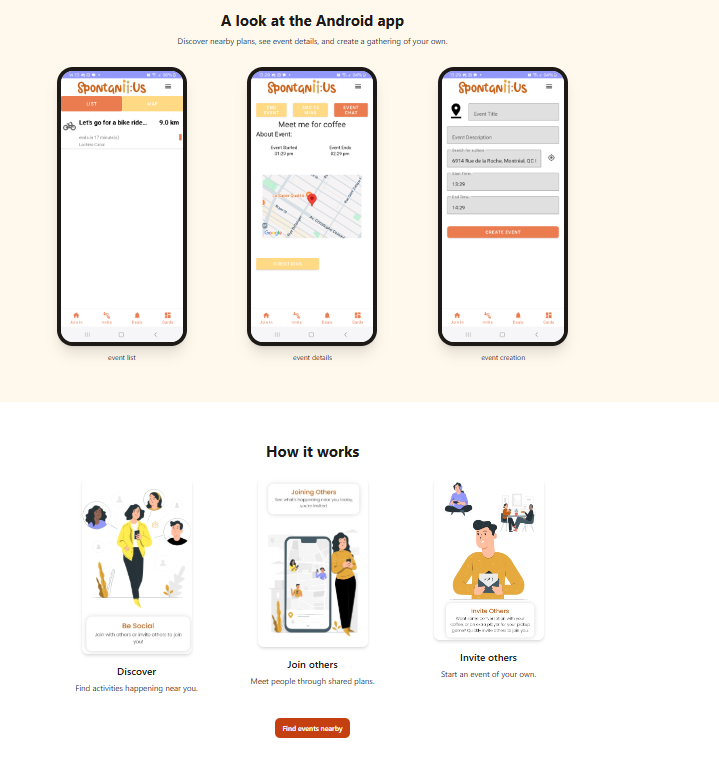
A few months of work and a lot of sharpening my app-development skills outside school later, I finally had something usable, with a distinct visual identity that I genuinely liked. During this time, I had also finished school and was preparing for an upcoming move across the continent.
It was around this point that I learned my first serious lesson about distribution: it’s hard. It’s particularly hard when you’re trying to bootstrap a user-generated platform with a cold-start problem on several sides.
- It’s hard to attract people looking to create events if there aren’t enough people showing up
- It’s hard to attract people looking for things to do if there aren’t enough events
- It’s hard to attract businesses without a customer base
- It’s even harder to do all of this when the usefulness of the platform is geographically constrained
With some major life changes approaching, I eventually put the project aside and moved on to other things. Later, I would occasionally pick it back up as a way of strengthening my technical skills and keeping alive, even if only as a technical demo, something I remained proud to have built.
Spontaniius also ended up helping me get my first professional development job: an Android and embedded development position at the startup Medipense. For that alone, I can easily say the project was worth building.
Along the way, it introduced me to:
- Mobile development and profiling
- Cloud development and AWS
- UX/UI design
- Project ownership
- Distribution, marketing, and the difficulty of finding actual users
It also taught me something that has stuck with me: building software and solving a problem are not quite the same thing. The engineering may be difficult, but sometimes getting people to use what you’ve built is harder.
Spontaniius never became the social platform I originally imagined. But it did almost everything I could reasonably have asked of a first serious project: it pushed me into unfamiliar areas of engineering, taught me to own a product end-to-end, gave me my first exposure to the problems of distribution, and helped me get my first development job.
Not too bad for a first project.
If you want to try it out, check out Spontaniius.com. And if you want to read about my experience bringing it back to life years later, you can read Technical Debt: Reviving a Four-Year-Old App.